PBnJ of Corpus Christi would like to connect it’s members to valuable resources in our community that can help us better understand the effects of our food choices on our lives and the life of our planet. In this interview, we introduce Melissa Zamora of Corpus Christi Texas Master Composters.
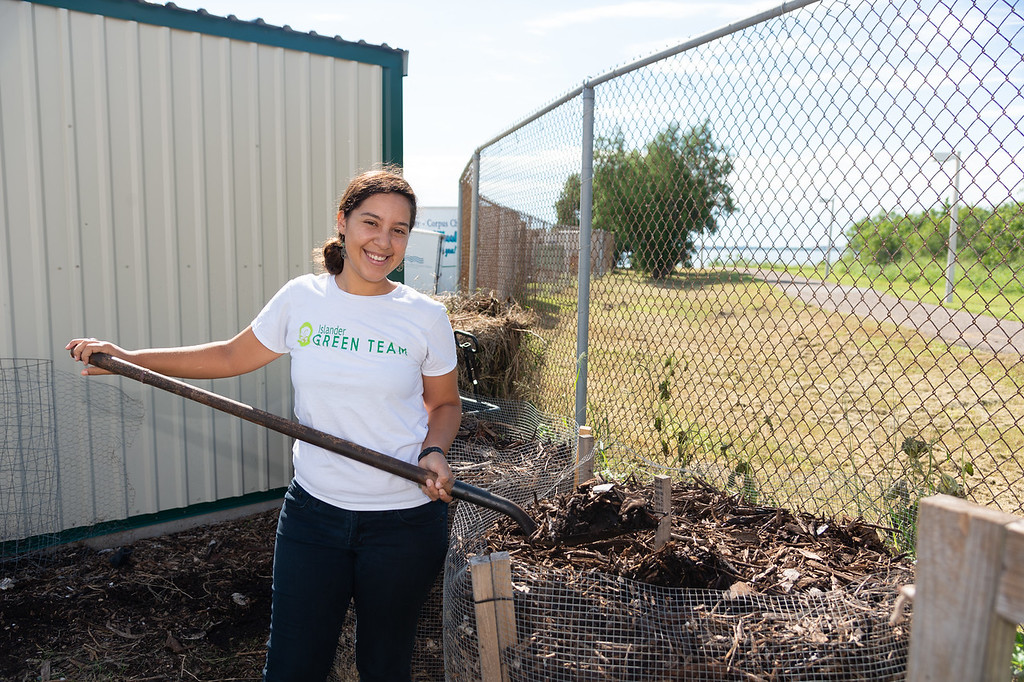
Melissa began her journey as a community advocate in 2012-2016 while serving as the Garden Facilitator at Clairelaine Community Garden. Among her many accomplishments, Melissa created & facilitated the Islander Green Compost Program at Texas A&M University Corpus Christi from 2016-2018. She then founded and served as President of The Islander Green Team at Texas A&M University Corpus Christi and is currently acting as staff advisor. Melissa has served as a core member of For the Greater Good since 2016. She is a member of the Coastal Alliance to Protect our Environment and is the Garden Facilitator at The Early Childhood Development Center. She holds an Associate’s degree in Biology from Del Mar College and a Bachelor’s degree in Environmental Science from Texas A &M University, Corpus Christi . Melissa is a Certified Texas Master Composter and is a Texas Master Composter Instructor. She played a principal role in establishing and maintaining the composting program at The South Texas Botanical Garden. In 2020, Ms. Zamora began partnering with Keepers of the Garden Space (a local community garden), to help manage their compost program. Melissa is a member of Kalpulli Ehekatl Papalotzin, a local native tribe and a member of The Indigenous People of the Coastal Bend.
Please share your thoughts about the following statement: A whole food, plant-based (WFPB) nutrition has the power to prevent, treat and in some cases actually reverse disease. Living WFPB improves the health of us, as individuals, as well as the health of the plant.
I completely agree with this statement. In the past, I was vegan for six years and was in the best shape of my life, I felt the difference physically, mentally and spiritually by eating cleaner. I have since had a child and have had a really hard time going back to my pre-pregnancy diet, but notice how bad I feel after eating meat or processed foods vs. how good I feel after eating fruits and veggies.
Q: What type of organization are you involve in and what services do you offer?
Currently I am very involved with the local Texas Master Composter program/organization, acting as lead instructor in the Corpus Christi area, I help folks learn how to garden and compost locally.
Q: What inspired you to take part in this organization ?
I want to help make a positive difference in this world, even if that means taking the time to teach others the value our food and yard waste has on helping to rebuild our connection to the land and each other. Helping us heal ourselves and the planet, as a whole, is something I take very seriously and strive for everyday through small actions that add up over time.
Q: Looking back at your time involved in the community , what are you most proud of?
I am most proud of the connections I have made with the loving people, plants and animals of this area.
Q: What is your biggest challenge in starting your organization and how did you overcome that?
My biggest challenge was learning how to create a good quality compost amendment. I overcame that by composting over and over and over again, learning from different people, books, websites, schools of trial and error, etc., until I finally understood how to create a decent quality compost that has helped local plants grow and improve the soil conditions I work with. However, I am still continuously learning and have much more knowledge to discover in terms of future local soil and compost studies.
Q: What is your favorite part of your work?
My favorite part of my work is being able to witness a compost pile transform, not only a garden space, but a growing community. The act of composting takes time, the lessons learned throughout this process are very special and will only be taught to those who care to listen. I, for one, love to visually see the various processes of decomposition from start to finish and to think about this transformation of time, space and energy in a metaphorical sense. The compost teaches me that we too can transform ourselves and our lives just as the materials in a compost pile can. These materials may seem ugly and rotten at first, but when we give them time and energy, (just like anything else), we can transform them into something sweet, rich and useful, not only for the soil it will mix into but the plants and people it will help grow for generations to come.
Q: Successfully adapting an organization is always a challenge, and doing so in a crisis on short notice requires much thought, creativity and flexibility. How have you adapted your organization during Covid-19?
We have begun adapting by taking extra precautions like reducing the amount of volunteers that come out to composting events, wearing masks and gloves and practicing social distancing. I have still not felt comfortable enough to continue picking up food scraps from local restaurants because of the exposure to various people going in and out of those places. I have a son with asthma that I am trying my best to keep healthy. I am currently looking for someone who is willing and able to help transport food waste from local coffee shops, stores or restaurants to our compost sites. If anyone with a truck or trailer is interested, we would appreciate your assistance with this task;)
Q: What are some ways our members and readers can support you during this time?
I am currently looking for someone who is willing and able to help transport food waste from local coffee shops, stores or restaurants to our current compost site. The community could also help by saving fruit/veggie scraps, egg shells, nut shells, and other compostables that they would be willing to drop off at one of our local compost sites! For more info email cctxmastercomposters@gmail.com
Q: What is your number one piece of advice for people who would like to become involved in at home composting?
Always mix at least 3 parts of brown, dry material (wood chips/mulch, leaves, hay, paper, etc.) to every 1 part green, wet material (fruits, veggies, coffee grounds, etc) to help provide a good balanced diet for your compost to flourish.
The interviewees in our posts share their experiences, skills and learned knowledge so that we can understand the importance of balance between nature and our lives. As Melissa so eloquently stated, as in the transformation of the compost in time, space and energy, we too can transform ourselves and our lives, by taking the time to evaluate our current lifestyle and finding the energy to necessitate change.
Life is a journey and we are perpetual students learning something new daily. Symbiosis in life is important not only for the health of our body and the soil under our feet but for the communities in which we live.
Please contact Melissa at cctxmastercomposters@gmail.com for volunteer opportunities and to learn more about composting programs.
 PBnJ of Corpus Christi